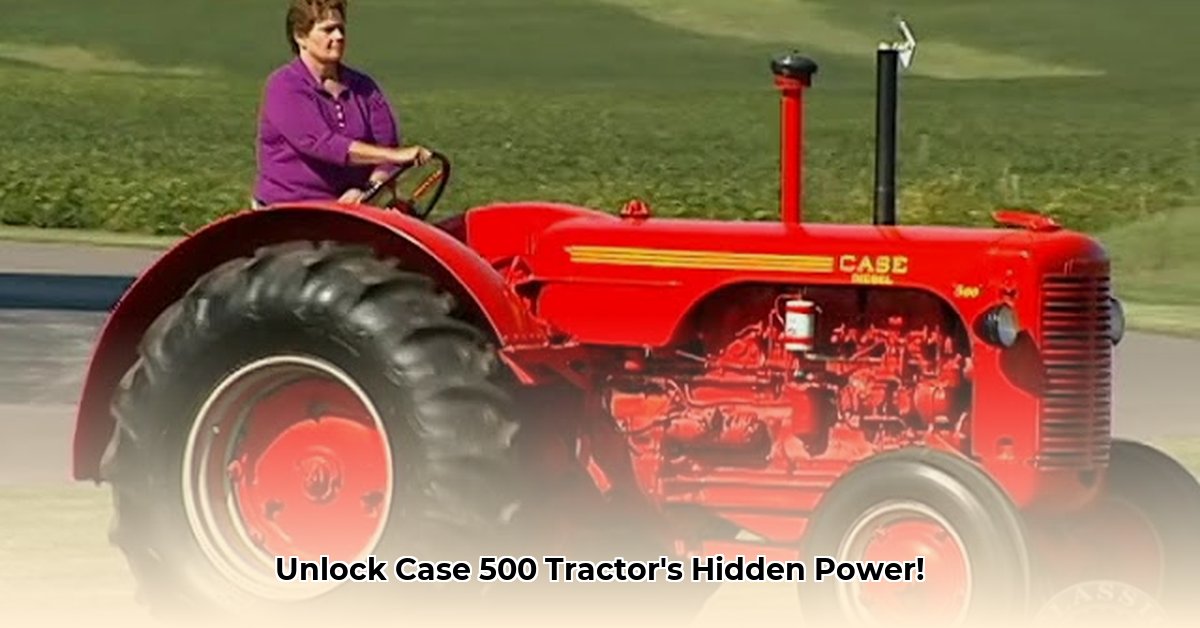
Case Tractor 500: A Farming Legend
The J.I. Case 500 tractor, a mid-20th-century workhorse, represents a significant chapter in agricultural technology. Produced between 1953 and 1957, this machine embodies the era's advancements in power and efficiency. This guide delves into its technical aspects, historical context, and significance for collectors. Understanding its nuances reveals much about the evolution of farming technology. Isn't it fascinating how a single machine can tell such a rich story? For more Case tractor models, check out this comprehensive guide.
Case 500: Technical Specifications and Performance
The Case 500's heart was a robust 6.2-liter, six-cylinder diesel engine – a powerful unit for its time. Case's advertised specifications claimed 44 drawbar horsepower (DBHP) and 55 PTO (power take-off) horsepower. However, independent testing revealed higher figures, approximately 56 DBHP and 63 PTO HP. This variance highlights the differences between manufacturer claims and real-world performance, influenced by testing methods and engine condition. What factors might explain this discrepancy in horsepower ratings?
| Specification | Value | Notes |
|---|---|---|
| Engine | 6.2L, 6-cylinder diesel | Reliable and powerful for its era. |
| Claimed Drawbar HP | 44 hp | Manufacturer's stated pull power. |
| Tested Drawbar HP | ~56 hp | Results from independent testing under various conditions. |
| Claimed PTO HP | 55 hp | Power available for implements like combines and balers. |
| Tested PTO HP | ~63 hp | Independent testing indicated a higher actual PTO horsepower output. |
| Transmission | 4-speed | Simple, robust design suitable for various agricultural tasks. |
| Weight | ~6,500 lbs | Varied slightly by model and configuration. |
| Production Years | 1953-1957 | A relatively short production run, contributing to its collector appeal. |
| Approximate Production | ~5,985 units | Limited production numbers increased its rarity and value today. |
Historical Context and Market Position
The Case 500 emerged during a period of significant advancements in agricultural mechanization. Positioned within J.I. Case's broader tractor lineup, it likely targeted medium-sized farms needing a reliable, powerful machine. Its diesel engine provided better fuel efficiency and torque compared to gasoline-powered competitors. How did its features compare to other tractors available in the 1950s? Research suggests it was a sturdy, efficient machine well-suited to a particular market segment.
The Case 520 Industrial Variant: Adaptability and Innovation
J.I. Case recognized the versatility of the 500’s design and created the Case 520, an industrial version. Modifications to this variant, including potentially reinforced components and specialized attachments, expanded its use beyond agricultural applications. This adaptability highlights the basic design's strength and the company's ability to repurpose it for different sectors. This diversification likely influenced the 500's impact on overall mechanization.
Collector's Guide: Restoration and Maintenance
The Case 500’s rarity makes it a highly sought-after collector's item. Restoring one requires patience and resources. Parts availability can be a challenge. Online forums, specialized websites, and dedicated Case parts suppliers are crucial resources. Engaging with other enthusiasts is essential for troubleshooting and sharing restoration tips. How do you identify genuine parts versus reproductions when restoring a tractor? Active participation in collector communities helps to greatly overcome this challenge.
Conclusion: A Lasting Legacy
The J.I. Case 500, though produced for a relatively short period, holds a significant place in agricultural history. Its powerful diesel engine and robust construction reflect the technological advancements of its time. It remains a testament to American ingenuity and a valuable piece of farming heritage, appreciated by collectors and enthusiasts alike. Its contribution to agricultural efficiency continues to resonate.